

A single unsuccessful Chief Nursing Officer (CNO) transition can cost a health system between $750,000 and $1.5 million, making structured nurse executive leadership development a financial risk management strategy, not just a professional development expense.
Yet healthcare organizations continue to place emerging nurse leaders into increasingly complex executive roles at the exact moment the industry is facing unprecedented workforce, operational, and financial pressure.
Health systems are flattening hierarchies, expanding spans of control, and consolidating accountability across multiple sites, service lines, and strategic priorities. Today’s nurse executives are expected to lead enterprise-wide transformation efforts while navigating workforce shortages, margin pressure, operational efficiency demands, and escalating expectations for performance improvement.
There is little margin for leadership instability.
At the same time, many organizations continue to rely heavily on internal promotions to fill essential executive leadership positions without providing structured transition support. High-potential leaders are often expected to immediately perform at the executive level while simultaneously mastering financial management, workforce strategy, operational oversight, physician relationships, and organizational politics.
That approach creates significant organizational risk.
Why Healthcare Executive Turnover Is So Expensive
Research demonstrates that nurse executive turnover has consequences far beyond recruitment expense.
The direct and indirect cost of a single Chief Nursing Officer (CNO) transition—including executive search, onboarding, interim leadership coverage, productivity loss, and operational disruption—can exceed $750,000 and may surpass $1.5 million in large health systems (Sherman, 2023).
Leadership instability also contributes to:
- stalled initiatives,
- workforce disengagement,
- increased premium labor utilization,
- delayed operational improvement efforts,
- and higher RN turnover.
Each 1% increase in RN turnover costs hospitals approximately $262,000–$295,000 annually (NSI Nursing Solutions, 2026).
When viewed through this lens, nurse executive leadership development is no longer simply a professional development initiative. It is a business continuity strategy.
Why Traditional Leadership Development Programs Fall Short
Many leadership programs still focus primarily on classroom learning, online modules, or theoretical concepts. While foundational education matters, healthcare organizations need leaders who can apply executive-level decision-making in real time.
Emerging leaders are not struggling because they have limited ambition or intelligence. They are struggling because the complexity of healthcare leadership has accelerated faster than most organizations’ leadership transition models.
The most effective nurse executive leadership development approaches combine:
- executive education
- competency assessment
- and individualized advising from experienced senior healthcare executives
This is particularly important in financial management, where many clinically strong leaders have had limited exposure to enterprise budgeting, labor management, productivity optimization, operational prioritization, and fiscal accountability.
Participant outcome data show the largest competency improvement in Financial Management, at +37%. That matters because stronger financial leadership capability directly impacts workforce management, operational execution, and organizational performance.
Measuring Leadership Development ROI in Healthcare
Healthcare organizations increasingly evaluate leadership development through the lens of operational and financial return—not simply participant satisfaction.
Conservative ROI modeling from executive transition support initiatives demonstrated substantial organizational savings:
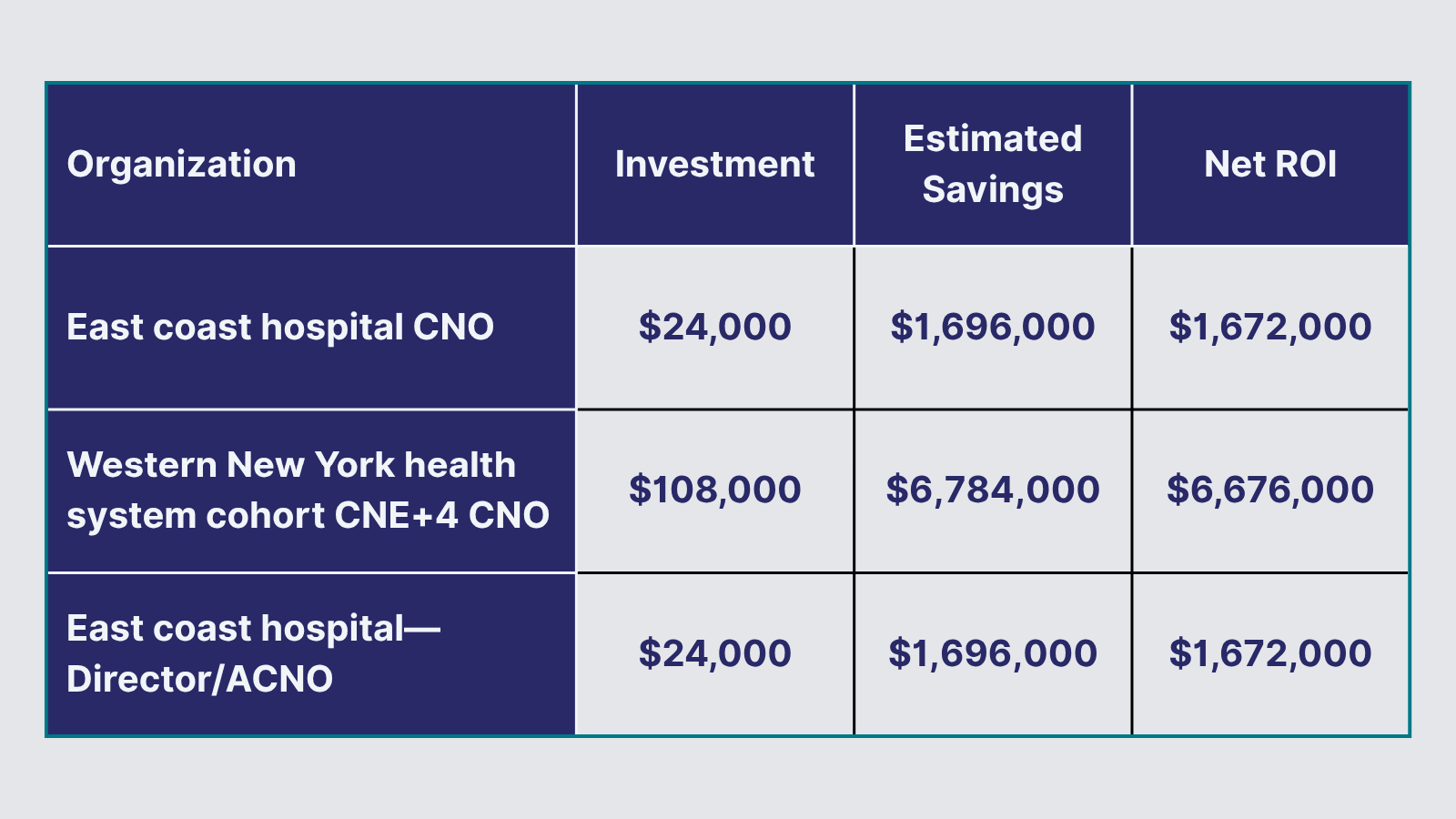
These estimates include avoided executive turnover costs, operational disruption, productivity loss, and workforce instability associated with unsuccessful leadership transitions.
Organizations that invest intentionally in leadership readiness are not simply developing leaders. They are protecting operational continuity, strengthening workforce stability, and reducing avoidable financial risk.
The Bottom Line: Leadership Development Is a Financial Strategy
Healthcare organizations can no longer afford to approach executive leadership transition and development as informal or unsupported processes.
Leadership development has evolved beyond professional development alone. It is now a strategic investment in organizational stability, financial performance, workforce retention, and long-term healthcare leadership sustainability.
Frequently Asked Questions
What’s The Cost Of CNO Turnover?
A single CNO transition often costs between $750,000 and $1.5 million when accounting for executive search fees, interim leadership coverage, onboarding, productivity loss, and operational disruption (Sherman, 2023).
How Is The ROI For Leadership Development in Healthcare Calculated?
ROI is modeled by comparing the cost of a structured transition support program against the avoided costs of executive turnover. Avoidable costs associated with nurse executive vacancies can include executive search fees, interim coverage, lost productivity, workforce instability, and delayed strategic initiatives. Conservative models have shown net returns exceeding $1.6 million per participant.
Why Do Nurse Executives Struggle With Financial Management?
Many clinically strong leaders have had limited exposure to enterprise-level budgeting, labor productivity optimization, and fiscal accountability before moving into executive roles. Structured leadership development programs that include financial management components, like Kirby Bates Associates’ Nurse Executive Gateway to Knowledge®, have shown competency improvements of up to 37%.
What’s The Impact of Leadership Instability on Nurse Retention?
Leadership instability is directly linked to workforce disengagement and increased RN turnover. Each 1% increase in RN turnover costs hospitals $262,000–$295,000 annually, so the downstream workforce costs of poor executive transitions are enormous (NSI Nursing Solutions, 2026).
References
Sherman, R. O. (2023). The high cost of chief nursing officer turnover. Nurse Leader, 21(4).
Nursing Solutions, Inc. (2026). 2026 National Health Care Retention & RN Staffing Report. NSI Nursing Solutions Report